
Ghana's Opposition Protests, Claims Democracy Is 'Under Attack'
Ghana's opposition has taken to the streets, accusing the government of undermining democracy and raising political tensions ahead of the country's next electoral milestones.
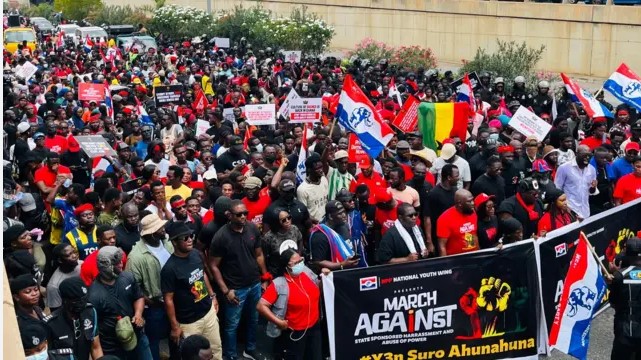
Thousands of supporters of Ghana's main opposition New Patriotic Party (NPP) marched through the streets of Accra on Thursday in a high-profile demonstration accusing the government of undermining democratic institutions, judicial independence and the rule of law, in what has become one of the country's most significant political protests since the 2024 elections.
The demonstration, organised under the theme "Democracy Under Attack," began near Ghana's Supreme Court before proceeding to Jubilee House, the seat of government, and Parliament. Protest leaders presented petitions to state institutions, arguing that recent actions by the administration of President John Dramani Mahama threaten the constitutional principles that have underpinned Ghana's democratic system for more than three decades.
NPP officials said the protest was intended to draw attention to what they describe as selective justice, political persecution of opposition figures and increasing interference in independent state institutions. They argued that safeguarding democracy requires strong checks and balances, regardless of which political party is in power.
The government has rejected accusations that Ghana's democratic system is under threat, insisting that state institutions continue to operate independently and in accordance with the country's constitution. Supporters of the ruling National Democratic Congress (NDC) have also criticised the demonstration, arguing that the opposition is attempting to politicise legal and governance issues after losing power. Some political commentators questioned the timing of the protest, noting that it coincided with the first anniversary of the military helicopter crash that claimed the lives of several senior government officials.
The protest unfolded under heavy police deployment but remained largely peaceful, with officers managing traffic and providing security along the approved route. Organisers urged participants to conduct themselves lawfully, while authorities worked to minimise disruption in central Accra.
Beyond the immediate political disagreement, the demonstration reflects a broader debate about democratic governance in Ghana. Long regarded as one of Africa's most stable democracies, the country has earned international recognition for peaceful transfers of power, competitive elections and relatively strong institutions. However, as in many democracies around the world, political competition has increasingly shifted toward disputes over the independence of public institutions, judicial processes and the balance between executive authority and constitutional oversight.
Political analysts say the latest protest illustrates the increasingly confrontational relationship between Ghana's two dominant political parties. With the next electoral cycle already beginning to shape political calculations, public demonstrations and institutional debates are expected to become more frequent as both sides seek to influence public opinion and frame the national political narrative.
For readers of FollowGlobalTrends.com, the events in Accra serve as a reminder that democracy is measured not only by elections but also by the public's confidence in institutions, accountability and the rule of law. Whether the opposition's concerns gain wider traction or the government succeeds in reassuring citizens, the debate underscores the importance of protecting democratic norms in one of West Africa's most influential political systems.