End of an Era: Super Falcons Miss World Cup for First Time in History
Nigeria’s World Cup hopes had already taken a major blow four days earlier when Cameroon eliminated them 1–0 in the quarter-finals. That defeat meant the Falcons missed out on the four automatic World Cup places reserved for the WAFCON semi-finalists.
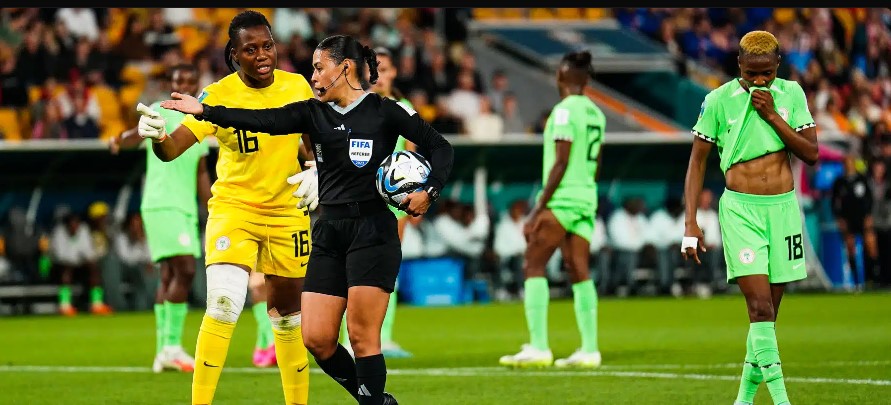
Nigeria’s Super Falcons will miss the FIFA Women’s World Cup for the first time in the competition’s history after a 2–1 defeat to South Africa ended their final qualification route at the 2026 Women’s Africa Cup of Nations in Morocco.
The loss in Casablanca completes a stunning collapse for a Nigerian side that arrived at the tournament as defending African champions and the continent’s record 10-time WAFCON winners.
Nigeria’s World Cup hopes had already taken a major blow four days earlier when Cameroon eliminated them 1–0 in the quarter-finals. That defeat meant the Falcons missed out on the four automatic World Cup places reserved for the WAFCON semi-finalists.
There was, however, one final escape route. The four quarter-final losers entered a play-off for two places in the intercontinental World Cup play-offs, leaving Nigeria needing to beat South Africa to keep its record of appearing at every Women’s World Cup alive.
Instead, the Falcons suffered another defeat.
South Africa finish the job
After a goalless first half, Thembi Kgatlana broke the deadlock for South Africa in the 56th minute before Refiloe Jane doubled Banyana Banyana’s advantage in the 77th.
Nigeria eventually found a lifeline in stoppage time when a VAR review resulted in a penalty. Christy Ucheibe converted from the spot, but the late goal came too close to the final whistle to change the outcome.
South Africa held on to claim one of the African places in the intercontinental play-offs.
Nigeria's World Cup journey, meanwhile, was over.
And the significance of that result goes far beyond one disappointing tournament.
A record that has finally ended
Since the inaugural FIFA Women's World Cup in 1991, Nigeria had been the only African team to appear at every edition.
That remarkable streak has now come to an end.
The Super Falcons had survived several difficult qualification campaigns over the years and remained a constant presence on the global stage even when their dominance of African football was challenged by countries such as South Africa and Cameroon.
Their absence from Brazil in 2027 will therefore represent one of the biggest shocks in the history of Nigerian women's football.
It is also a dramatic reversal from the team's recent success.
Nigeria entered the 2026 WAFCON as the defending champions after winning a record-extending 10th continental title in 2025. Expectations were consequently high that the Falcons would once again be among Africa's leading contenders.
Instead, their tournament unravelled almost immediately.
Nigeria opened the competition with a 3–2 defeat to WAFCON debutants Malawi, before recovering with victories over Zambia and Egypt to reach the quarter-finals. Cameroon then delivered the decisive blow to their title defence.
The quarter-final defeat was itself historic.
Nigeria had previously reached at least the semi-finals in every edition of the WAFCON, making the early elimination its worst-ever finish in the competition.
African women's football is changing
The Falcons' downfall also tells a larger story about the changing balance of power in African women's football.
Nigeria remains the continent's most successful women's national team, but the gap separating the traditional powerhouse from its challengers has narrowed considerably.
South Africa are the reigning continental champions after winning the 2022 tournament, while Morocco have emerged as a major force. Cameroon remain perennial contenders, and this year's competition has also produced breakthrough performances from teams such as Malawi and Algeria.
Malawi, ranked far below Nigeria before the tournament, reached the semi-finals and secured its first-ever Women's World Cup qualification, underlining just how dramatically the competitive landscape has shifted.
Nigeria's failure therefore cannot simply be dismissed as an isolated bad night.
The tournament exposed a team that struggled to convert its experience and reputation into consistent results when the pressure became greatest.
What happens next for the Falcons?
The immediate question will be what the Nigerian Football Federation does with the lessons from Morocco.
There will inevitably be debate about coaching, player selection, preparation, tactics and the wider structure supporting the women's national team.
But the bigger challenge is rebuilding without the safety net of another World Cup campaign.
The Falcons have traditionally used the World Cup as one of the biggest stages for showcasing Nigerian women's football. Missing Brazil 2027 means a generation of players and supporters will experience something the country has never faced before.
It also gives the NFF a rare opportunity to rethink how the women's national team is developed between major tournaments.
For FollowGlobalTrends, this is more than a football upset. Nigeria has not simply lost a quarter-final or missed one qualification opportunity. The Super Falcons have lost a World Cup place that had appeared almost guaranteed by history.
The team that arrived in Morocco as Africa's most decorated women's side will leave without the continental crown and without a ticket to Brazil. And for the first time since the Women's World Cup began, Nigeria will be watching from home.