Davido’s Osun Claim: ‘I Defeated 17 Governors With Just My Phone’
Davido has described his role in Ademola Adeleke’s re-election campaign as a demonstration of social media’s power to challenge established political structures, saying he relied largely on his phone to make an impact.
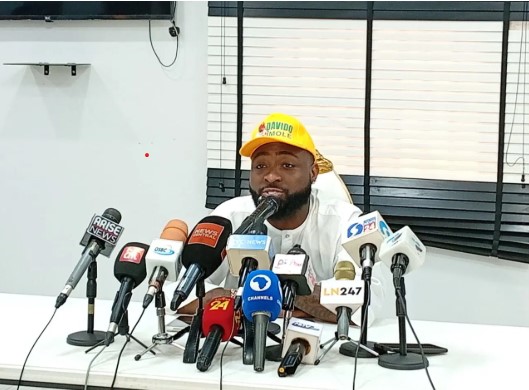
Afrobeats superstar David Adeleke, popularly known as Davido, has portrayed his role in his uncle Ademola Adeleke’s re-election campaign as an example of how social media can challenge traditional political power, claiming he confronted a formidable political establishment armed largely with nothing more than his phone.
Speaking to journalists in Osun on Tuesday after the governor secured a second term, Davido described the August 15 governorship election as more than an ordinary political contest. He said the Adeleke campaign faced what he described as a powerful coalition of 17 governors, 50 senators and members of the House of Representatives, yet still emerged victorious.
In a separate post-election exclusive interview with News Central TV, Davido framed his own contribution in even more striking terms, saying he had defeated governors with their political influence, security machinery and financial resources while relying on his mobile phone and social-media reach. The claim has quickly become one of the most attention-grabbing soundbites from the aftermath of the election.
Whatever the precise scale of the political forces involved, the election result gives context to Davido's confidence. The Independent National Electoral Commission declared Adeleke the winner with 511,067 votes, ahead of APC candidate Bola Oyebamiji, who secured 444,815 votes. Adeleke carried 19 of Osun's 30 local government areas, while Oyebamiji won 11.
Davido's involvement had been unusually visible for a celebrity. He openly campaigned for his uncle, used his large online following to promote the governor's candidacy and remained active around the election. After the result was announced, he praised Osun voters for what he described as standing their ground and protecting their votes from the polling units through the collation process.
For Davido, however, the victory was not simply about family. He argued that Adeleke's re-election demonstrated a broader political principle: leaders who genuinely serve their communities can build a level of loyalty that political machinery cannot easily overcome. “If you work well for the people, the people will work well for you,” he said, presenting his uncle's victory as a lesson for governors and other public officials.
The singer's comments also underline how dramatically Nigeria's political communication landscape has changed. A celebrity with millions of followers can now reach voters directly, bypassing traditional campaign structures and giving public figures a platform that can rival the reach of established political organizations.
That does not mean a phone alone wins an election. Adeleke's victory was the product of a much larger campaign involving political organization, party structures, local mobilization and, ultimately, voters casting ballots across the state. Davido's influence is therefore best understood as part of a wider campaign rather than a substitute for conventional electoral machinery.
His post-election role may now shift towards youth and sports development. As chairman of the Osun State Sports Trust Fund, Davido said he plans to support the development of sporting facilities, including a proposed recreational centre featuring football, basketball, swimming, athletics and other activities. He also disclosed plans for a concert in Osun once the stadium project is completed.
The bigger story, though, is the changing relationship between entertainment and politics. Davido's intervention shows that Nigeria's celebrities are no longer confined to endorsing candidates from the sidelines. With massive digital audiences and the ability to shape conversations instantly, some are becoming political actors in their own right.
In Osun, Davido may not have literally defeated 17 governors with a phone, but his claim captures a changing reality: in modern Nigerian politics, influence can travel from a smartphone screen to the ballot box, and celebrities increasingly know how to make that journey.