
China’s Xi Backs Hichilema’s Second Term as Zambia’s Copper Stakes Rise
Chinese President Xi Jinping has congratulated Hakainde Hichilema on his re-election, signalling Beijing’s interest in deepening ties with Zambia.
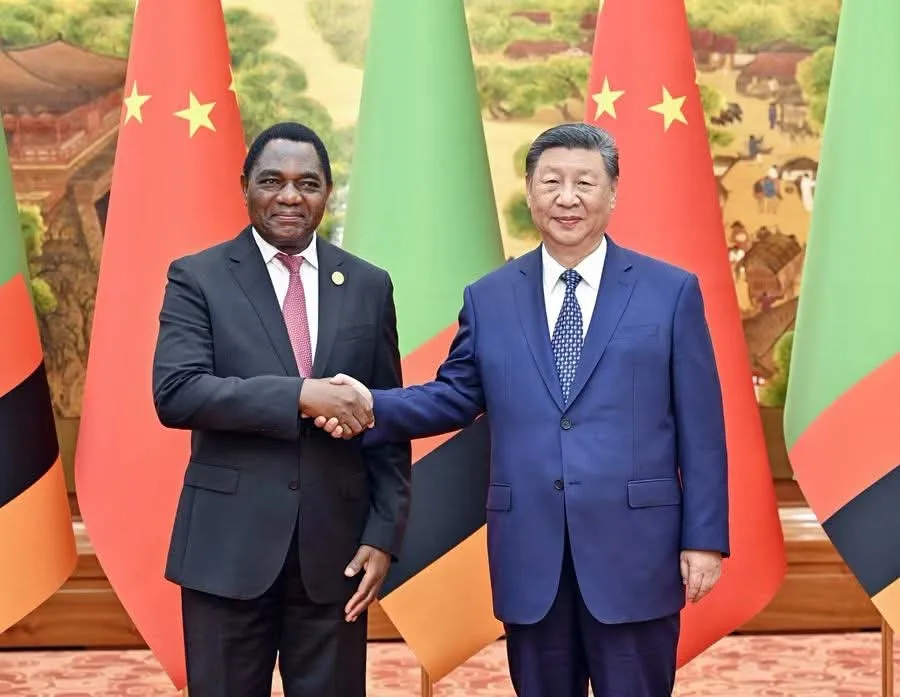
Chinese President Xi Jinping has congratulated Zambia’s President Hakainde Hichilema on winning a second term, saying Beijing is ready to work with his government to deepen political ties and expand economic cooperation.
In a message sent on August 20, Xi said China and Zambia had continued to strengthen political trust and achieved “fruitful” results in practical cooperation. He said the two countries should work together to implement the outcomes of the Beijing Summit of the Forum on China-Africa Cooperation (FOCAC), while taking their comprehensive strategic cooperative partnership to a higher level.
Xi also noted that he and Hichilema had met twice in recent years and had jointly guided the development of bilateral relations. Beijing said the two countries have maintained close coordination on multilateral issues and that China attaches considerable importance to the relationship.
The congratulatory message came days after Zambia’s Electoral Commission declared Hichilema the winner of the August 13 presidential election. The incumbent secured roughly 60% of the vote, defeating his closest challenger, Brian Mundubile, who received about 38%, according to Reuters. Hichilema therefore secured a second five-year term without the need for a runoff.
The election result, however, has not gone uncontested. Mundubile has said he will challenge the outcome in court, alleging “serious irregularities” in the conduct, counting, transmission and declaration of the results. The Electoral Commission also temporarily suspended counting after reports of violence against electoral officials and the theft of ballot papers. Those allegations remain subject to the legal process and have not been established as proof that the result was fraudulent.
The post-election environment has added another layer of uncertainty. Zambian authorities arrested 11 people, including opposition figures, following a security raid that involved an exchange of gunfire. Former government minister Mutotwe Kafwaya was killed during the incident. Police have accused opposition figures of involvement in a plot threatening national security, while Mundubile has rejected the allegations as fabricated. The UN human rights chief has expressed concern over the arrests and called for due process.
For Beijing, however, the election result provides continuity in a relationship that has become increasingly important to both sides. Zambia and China established diplomatic relations in 1964, and their ties were upgraded to a comprehensive strategic cooperative partnership during Hichilema’s state visit to China in 2023.
Economic cooperation is central to that relationship. Zambia is one of Africa’s major copper producers, making it strategically important as global demand rises for critical minerals used in electric vehicles, renewable-energy systems and other technologies. Hichilema has pledged to significantly increase copper production during his second term, while Zambia has also attracted growing interest from both China and the United States.
Chinese companies are already involved in major Zambian infrastructure and energy projects. In April, for example, Hichilema attended the commissioning of the 136MW Itimpi Solar Plant, which was constructed by Chinese company TBEA. The Zambian president said the project would help diversify the country's energy mix and expressed interest in expanding cooperation with China in energy, agriculture and mining.
The relationship is not without complexity. Zambia's dependence on copper and the growing international competition for critical minerals mean Hichilema's second term will be closely watched by both Beijing and Washington. Investors are also looking for continued economic stability after Zambia emerged from its 2020 sovereign debt default, while the government faces pressure to translate macroeconomic improvements into better living conditions for citizens.
Xi's message therefore carries significance beyond a routine diplomatic congratulations. By explicitly referring to FOCAC commitments, mutual support and deeper economic cooperation, Beijing is signaling that it expects the China-Zambia relationship to remain an important part of its engagement with southern Africa.
For Hichilema, the immediate challenge is to turn electoral victory into political stability while addressing the concerns raised by the opposition and international observers. For China, his return offers continuity at a time when Zambia's copper, energy and infrastructure sectors are becoming increasingly important in the global competition for strategic resources. How Hichilema balances those external partnerships while meeting domestic expectations could determine whether Zambia's second term becomes a period of deeper investment and growth or another chapter of political and economic tension.