Carney Gives Trump a ‘Reality’ Check as Canada Rejects ‘Lake America’ Name
Mark Carney has rejected Donald Trump’s attempt to rename Lake Ontario, arguing that history, not a presidential order, determines what the shared lake is called.
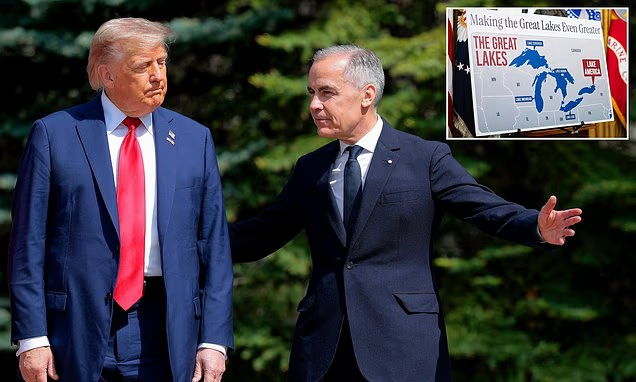
Canada’s Prime Minister Mark Carney has pushed back firmly against U.S. President Donald Trump’s decision to rename Lake Ontario “Lake America,” saying Canadians will continue to use the lake’s established name despite the American order.
Trump signed an executive order on Thursday directing the U.S. government to rename Lake Ontario as Lake America in federal usage, following his earlier threat to make the change amid an increasingly bitter trade dispute with Canada. The order instructs the U.S. Interior Department and the U.S. Board on Geographic Names to update America’s official Geographic Names Information System within 30 days.
Carney’s response was notably less theatrical. In a post on X, he pointed to the history behind the name, noting that “Ontario” is derived from a Wendat word and that the name is more than 400 years old, predating both Canadian Confederation and the United States Declaration of Independence.
“Canadians also know that naming reality means calling it Lake Ontario, then, now and always,” Carney said.
The distinction matters because Trump’s order governs the U.S. federal government, not Canada. Lake Ontario is a shared international waterway, with the border between New York and Ontario running through it. The executive order therefore cannot compel Canadian authorities, international organisations or other countries to adopt the American terminology.
That shared status is more than a matter of cartography. Canada and the United States have spent decades developing joint mechanisms for managing the Great Lakes and other boundary waters. The International Joint Commission, established under the 1909 Boundary Waters Treaty, oversees issues involving shared waters, while the Lake Ontario–St. Lawrence River system is managed through agreements involving both countries.
Trump, however, framed the renaming as a recognition of what he described as America's contribution to the Great Lakes. His executive order argues that the United States is the “greatest protector” of the Great Lakes and highlights American investment in the freshwater system, shipping and infrastructure. It also points to the lake’s importance to American commerce, settlement and military history.
The move comes at an unusually tense moment in U.S.-Canada relations. Trade negotiations between Washington and Ottawa collapsed last week, after which Trump imposed 50% tariffs on about $20 billion worth of Canadian imports. Canada has responded with retaliatory measures of its own, with further tariffs scheduled to take effect on September 8.
Trump had first floated the Lake America idea on social media on Tuesday, linking it directly to the dispute with Ontario. He said the United States was considering the change because it did not expect to be doing much business with the Canadian province. The proposal quickly became another flashpoint in an already highly personal dispute between Trump and Carney.
Canadian officials have largely refused to treat the renaming as a serious alteration to the lake itself. Ontario Premier Doug Ford has also said the lake will remain Lake Ontario from the Canadian side, while New York Governor Kathy Hochul has rejected the new name as well.
There is also a practical question surrounding Trump's order. While the United States can determine how its own federal agencies refer to geographic features, changing the name of a body of water shared with another sovereign country is a different matter. The lake's established name is embedded in international maps, treaties, scientific research, commercial activity and decades of cross-border cooperation.
For Carney, that appears to be precisely the point. Rather than allowing the dispute to become a contest over who can produce the louder political gesture, the Canadian prime minister has attempted to anchor the argument in history and the practical reality of a shared waterway.
The episode also follows Trump's earlier attempt to rename the Gulf of Mexico as the Gulf of America, another move that changed U.S. federal usage without automatically altering how the rest of the world refers to the body of water. The Lake Ontario dispute goes a step further, however, because the lake directly borders another sovereign country and carries a name rooted in Indigenous history that predates both modern nations.
For now, the result is two official realities: American federal agencies are being instructed to use “Lake America,” while Canada has made clear that it will continue calling the lake Lake Ontario. What began as another provocative gesture in a trade fight has therefore become a broader test of how far unilateral political decisions can reach when geography, Indigenous history and international cooperation collide. And Carney's message is simple: a presidential pen may change what appears on a U.S. government map, but it does not necessarily change reality on the ground or on the water.