
Canada Strikes Back With Up to 50% Tariffs on US Goods as Trump Trade War Escalates
Canada has announced tariffs of up to 50 per cent on about C$27.6 billion of US goods, escalating a trade confrontation with Washington that now threatens one of the world’s most important economic relationships.
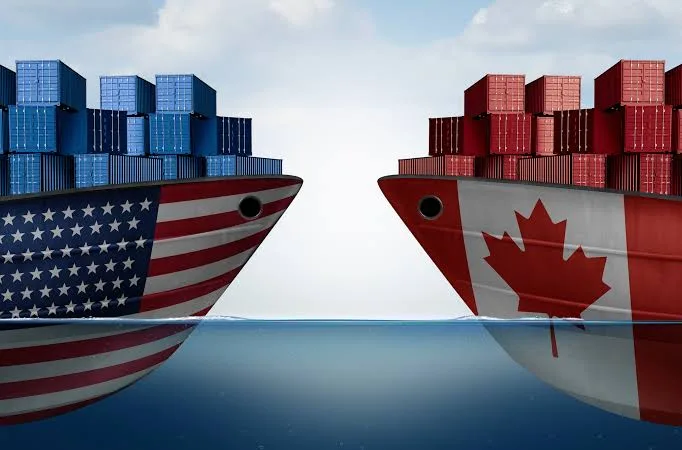
Canada has formally hit back at the United States, announcing retaliatory tariffs of 15, 25 and 50 per cent on hundreds of American products after President Donald Trump imposed a fresh round of steep duties on Canadian goods.
The Canadian government said Tuesday that the new counter-tariffs will take effect at 12:01 a.m. on September 8, covering products worth about C$27.6 billion in annual US imports. The measures are designed to match the corresponding American tariffs rate for rate and will affect more than 700 product categories.
Among the targeted goods are US steel and aluminium, furniture, clothing, dairy products, appliances, agricultural equipment, pulp and paper, plastics and electronics. Some everyday consumer products, including seafood and other food items, are also affected, meaning the consequences could extend beyond major industrial companies to retailers and households.
Finance Minister François-Philippe Champagne described the move as a necessary response to what Ottawa considers unjustified American tariffs. The Canadian government says its objective is not simply to punish US exporters but to give Canadian businesses affected by Washington's measures a better chance of competing in their home market.
The retaliation follows Trump's decision to impose 50 per cent tariffs on C$27.6 billion of Canadian goods, effective August 22. Those American measures came after intensive trade negotiations between Ottawa and Washington collapsed, with both governments blaming the other for the breakdown.
Prime Minister Mark Carney had warned over the weekend that Canada would respond “dollar for dollar”. He has since acknowledged that retaliation carries its own cost, including higher prices and fewer choices for Canadian consumers, but argued that Ottawa could not accept what he described as unacceptable US demands.
The dispute has also widened beyond the immediate tariff lists. Trump has threatened further action against Canada's automotive sector, while Canadian provincial leaders have discussed using Canada's energy and critical-mineral supplies as additional leverage if Washington continues escalating.
Ontario Premier Doug Ford has been particularly forceful, warning that his province could consider measures affecting electricity exports to the United States. Such threats have added another layer to a dispute that already reaches across manufacturing, agriculture, energy and technology.
For Ottawa, however, there is a delicate balance to maintain. Canada and the United States have extraordinarily integrated supply chains, and the two countries conduct hundreds of billions of dollars in trade each year. Tariffs imposed on one side can therefore create costs for businesses and consumers on the other, even when governments intend them to protect domestic industries.
The Canadian government is attempting to cushion some of that impact. Alongside the counter-tariffs, Ottawa announced a C$7.5 billion package of new and enhanced support for workers and businesses affected by the trade dispute. That comes on top of nearly C$25 billion in measures already introduced since the wider tariff confrontation began.
The timing also leaves a window for diplomacy. The Canadian tariffs do not take effect until September 8, giving the two governments roughly two weeks to return to negotiations if political conditions allow. Analysts have noted that the sheer scale of economic interdependence gives both sides strong reasons to prevent the dispute from developing into a prolonged, across-the-board trade war.
Washington, meanwhile, has shown little sign of backing away. Trump has continued to accuse Canada of treating the United States unfairly and has warned of further consequences, while his administration's latest tariff measures have already pushed the relationship to one of its most difficult points in decades.
What makes the confrontation particularly consequential is that this is not a dispute between distant trading partners that can easily walk away from one another. Canada and the United States share deeply intertwined industries, workers, energy networks and consumer markets. Canada's decision to retaliate therefore marks more than another exchange of tariffs: it is a clear signal that Ottawa is prepared to absorb economic pain rather than simply accept Washington's terms. Whether that pressure eventually brings the two sides back to the negotiating table, or locks them into a much deeper trade conflict, could shape North American commerce for years to come.