
Canada Strikes Back as Trump’s Trade War Puts Mark Carney to His Biggest Test
Canada is preparing fresh retaliation against the United States as Mark Carney confronts the biggest economic and political challenge of his premiership.
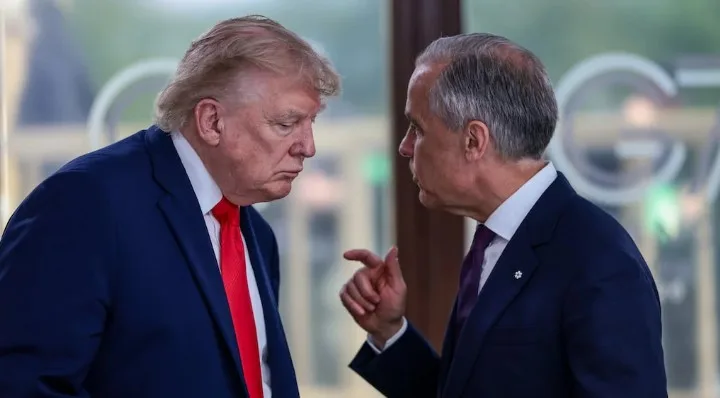
Canada is preparing to strike back at the United States on Tuesday as Prime Minister Mark Carney faces his most consequential test yet, with Donald Trump escalating a trade confrontation that is rapidly becoming a wider battle over Canada's economic independence.
Ottawa is expected to unveil its latest retaliatory measures after Washington imposed 50 per cent tariffs on more than 550 Canadian products worth about US$20 billion. The new U.S. duties, covering goods ranging from honey and cosmetics to hockey equipment and electronics, followed the collapse of trade negotiations between the two countries late last week.
Carney had originally promised that Canada would respond dollar-for-dollar to the new American tariffs, with countermeasures scheduled to take effect on September 8. But the prime minister signaled Monday that Ottawa could move away from a simple mirror-image strategy and instead concentrate its retaliation on carefully selected U.S. industries, an indication that Canada is trying to maximize the political and economic pressure on Washington while limiting damage to Canadian consumers.
The deterioration has been remarkably swift. Negotiators had spent weeks working towards an agreement that both sides had at various points suggested was within reach. Instead, Carney ordered Canada's negotiating team home after Washington introduced terms Ottawa considered unacceptable. The two governments now offer sharply different accounts of why the deal collapsed.
Carney says the United States ultimately demanded too much while offering too little, including proposals that he regarded as threatening Canada's sovereignty and the future of key industries. In his address to Canadians, he said Ottawa would not accept conditions that compromised its ability to make independent trade decisions or weakened protections for French language and Canadian culture.
Washington has a different explanation. U.S. Trade Representative Jamieson Greer accused Canada of introducing new demands and backing away from commitments reached during the negotiations. The Trump administration has also continued to argue that Canada's trade policies disadvantage American businesses.
Trump has now taken the dispute into increasingly personal territory. He has told Canadian leaders to “fall in line” and warned of consequences beyond the tariffs already imposed, while accusing Canada of exploiting the United States. The president has also threatened to raise tariffs on Canadian vehicles, trucks and auto parts to 50 per cent from January 2027, increasing pressure on an industry whose supply chains cross the border repeatedly during production.
Carney, meanwhile, is presenting the confrontation as something larger than a conventional tariff dispute. In a speech on Saturday, he argued that the negotiations had exposed a fundamental disagreement over whether Canada would remain an independent economic partner or become increasingly subordinate to Washington. He said the government was not prepared to sacrifice Canada's sovereignty or its major industries simply to secure a deal.
That position has attracted unusually broad political support. Ontario Premier Doug Ford, a Progressive Conservative and therefore from a different political camp than Carney's Liberals, has urged Ottawa to consider using Canada's economic leverage if Trump continues escalating. Ford has warned that “everything's on the table”, including electricity exports to the United States and access to critical minerals.
Electricity could become a particularly potent weapon. Ontario supplies power to millions of American homes and businesses, and Ford has previously used the threat of higher electricity prices as leverage during the trade dispute. Canada's wider energy position is even more significant: Carney has pointed out that Canada supplies the United States with the overwhelming majority of its imported natural gas, most of its electricity imports and a large share of its crude oil.
Critical minerals provide another potential pressure point. Washington is increasingly seeking reliable supplies of minerals needed for advanced manufacturing, electronics and defence production as it attempts to reduce its dependence on China. Any decision by Canada to restrict or price those resources more aggressively could therefore reach beyond the immediate tariff dispute and into American industrial and national-security calculations.
The danger for Ottawa is that escalation works in both directions. Canada and the United States have one of the world's most deeply integrated trading relationships, with goods, energy and components moving across the border daily. In 2025, the two countries traded an estimated $869.7 billion in goods and services. A prolonged tariff battle could therefore increase costs for Canadian households and businesses while also feeding inflation and supply-chain problems in the United States.
That is why Carney is trying to pair retaliation with a broader economic strategy. His government says it has already committed billions of dollars to protect workers and businesses affected by U.S. tariffs and is accelerating efforts to develop markets outside America. Ottawa says Canada has signed more than 20 economic and security partnerships over the past year and is seeking deeper commercial ties with countries across Asia, Europe and the Middle East.
The strategy is politically significant because Carney entered office promising Canadians that they would not have to simply accept Trump's demands. His challenge now is proving that defiance can be translated into economic resilience. It is one thing to reject an unfavourable trade deal; it is another to absorb the consequences when the country doing the pressuring is Canada's overwhelmingly dominant trading partner.
For Trump, the confrontation is also becoming a test of how far tariff pressure can force a close ally to yield. For Carney, it is a test of whether Canada can resist that pressure without inflicting disproportionate damage on its own economy. The outcome could shape not only the future of the world's largest bilateral trading relationship, but also Canada's long-term decision about whether its economic future remains tied overwhelmingly to Washington or becomes genuinely diversified.
What began as a dispute over tariffs is therefore becoming something much bigger. Canada is being forced to decide how much economic pain it is willing to absorb in defence of sovereignty, while the United States is discovering that its northern neighbour has more leverage than its size might suggest. For Mark Carney, the response he delivers now could define his premiership, and determine whether Canada's new push for economic independence becomes a durable national strategy or an expensive reaction to Trump's pressure.