Atiku Says Bigger Naira Numbers Mask Declining Purchasing Power
ADC presidential candidate Atiku Abubakar says Nigeria’s rising FAAC revenues and bigger naira figures mask a deeper economic reality of weaker purchasing power, mounting debt and declining living standards.
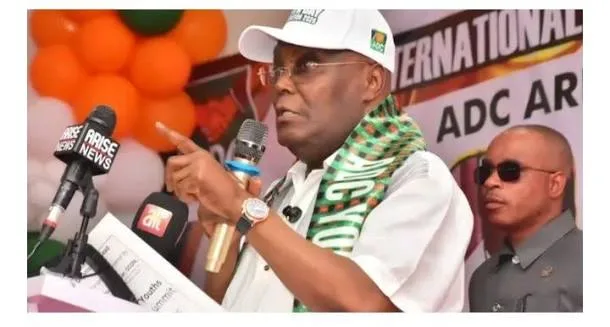
Former Vice President and African Democratic Congress (ADC) presidential candidate, Atiku Abubakar, has criticized the Tinubu administration’s celebration of record government revenues, arguing that larger naira figures have failed to translate into real economic value for ordinary Nigerians. Wikipedia
In a statement issued by his Senior Special Assistant on Public Communication, Phrank Shaibu, Atiku said the Federal Government’s emphasis on rising Federal Account Allocation Committee (FAAC) distributions creates what he described as a “money illusion”, a situation where nominal income and government revenue increase while the purchasing power of the naira continues to decline.
According to him, the true measure of economic progress is not the amount of money entering government accounts but the value that money delivers in infrastructure, public services and the daily lives of citizens.
“The arithmetic is brutal,” Atiku said, comparing FAAC distributions in 2019 with those of 2025.
The ADC candidate claimed that FAAC allocations rose from approximately ₦7.85 trillion in 2019 to about ₦21.9 trillion in 2025, suggesting an almost threefold increase in naira terms. However, he argued that when converted to dollars, the value fell from roughly $25.6 billion to $14.6 billion, representing a decline of more than 40 percent.
“That is not an economic miracle. That is money illusion,” he said. “You cannot batter the currency, allow inflation to ravage purchasing power and then wave bigger naira figures before Nigerians as evidence that the country has become richer.”
Atiku said the same pattern is evident in the earnings of Nigerian workers. Using the national minimum wage as an example, he noted that the ₦30,000 wage introduced in 2019 was worth about $83 at the prevailing exchange rate, compared with roughly $65 by May 2023. Although the minimum wage has since increased to ₦70,000, he argued that its value has fallen further to approximately $53 because of the naira’s depreciation.
“The figure in your hand is bigger, but the value in your pocket is smaller,” he said.
According to Atiku, this explains why many Nigerians continue to struggle with the rising cost of food, transportation, electricity, medicine and housing despite receiving higher nominal incomes. He maintained that wages cannot be considered an improvement if inflation consistently erodes what households can actually afford.
The former vice president also questioned why many state governments remain heavily indebted despite what he described as unprecedented FAAC inflows. Citing recent Debt Management Office figures, he claimed that 12 states whose governors are approaching the end of their tenures owe a combined ₦5.3 trillion, including about ₦2.16 trillion in domestic debt and $2.33 billion in foreign obligations.
“If the states are swimming in unprecedented revenues, why are they still drowning in debt?” he asked.
Beyond revenue, Atiku called for broader scrutiny of government spending, tax concessions, import waivers, revenue exemptions and abandoned projects, arguing that fiscal discipline should apply equally across all areas of public finance rather than placing the burden primarily on citizens.
“Revenue is not an achievement merely because it enters a government account. The achievement is what that revenue buys, what debts it settles, what infrastructure it delivers and how much better it makes the lives of the people.”
The criticism comes as economic performance emerges as the defining battleground ahead of the 2027 presidential election. The Tinubu administration has consistently defended its reforms, including fuel subsidy removal and foreign exchange liberalization, as necessary structural adjustments aimed at restoring fiscal stability, improving public revenue and attracting long-term investment. Government officials argue that stronger macroeconomic indicators will ultimately translate into broader economic growth, even as households continue to contend with elevated living costs. Reuters
Atiku, however, insists that Nigerians judge the economy through everyday experience rather than official statistics.
“Nigerians do not eat FAAC figures. They do not pay school fees with percentages. They do not buy medicine with press conferences.”
As the 2027 campaign gradually takes shape, the debate is increasingly shifting from headline revenue figures to a more fundamental question: whether economic reforms have genuinely improved the lives of ordinary Nigerians. That contrast, between stronger government accounts and weaker household purchasing power, is likely to become one of the defining issues of the next presidential election.